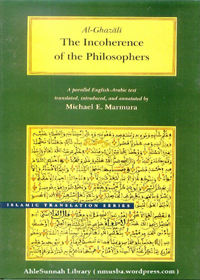
Incoherence of the Philosophers English Abu Hamid Al-Ghazali
Incoherence of the Philosophers
English
Abu Hamid Al-Ghazali
Translated by
Michael E. Marmura
Additional information
| Book Writer | Abu Hamid Muhammad ibn Muhammad al-Tusiyy al-Ghazali, Michael E. Marmura |
|---|---|
| Language | |
| File Size | 19 MB |
Description
Overview
“Incoherence of the Philosophers” is a seminal work by the renowned Islamic scholar Abu Hamid Al-Ghazali, who made significant contributions to Islamic philosophy and theology in the 11th century. In this critical text, Al-Ghazali addresses the philosophical doctrines of his time, particularly those of the Aristotelian tradition, and presents a compelling argument against the rationalist approach that was prevalent among many Muslim philosophers. His work is not only a critique but also a defense of Islamic orthodoxy, emphasizing the limitations of human reason in comprehending divine truths. The translation by Michael E. Marmura makes Al-Ghazali’s profound insights accessible to a wider audience, allowing readers to engage with the intricate interplay between faith and reason in Islamic thought.
Key Themes
The “Incoherence of the Philosophers” delves into several key themes that are pivotal to understanding Al-Ghazali’s philosophical stance:
- Critique of Rationalism: Al-Ghazali argues that reliance solely on reason can lead to erroneous conclusions about the divine and the nature of existence.
- Faith and Knowledge: The text explores the relationship between faith and knowledge, asserting that divine revelation surpasses human intellect.
- Philosophical Limitations: Al-Ghazali identifies the limitations of philosophical inquiry and the importance of humility in the pursuit of knowledge.
- Defense of Islamic Theology: The work serves as a robust defense of Islamic theological principles against philosophical skepticism.
Who This Book Benefits
- Students and scholars of Islamic philosophy seeking to understand the critiques of rationalism.
- Anyone interested in the historical context of Islamic thought and its evolution.
- Readers looking to explore the relationship between faith and reason in a religious context.
- Philosophers and theologians who wish to engage with Al-Ghazali’s arguments and their implications for contemporary thought.
- General readers who are curious about the intellectual heritage of Islam and its prominent figures.