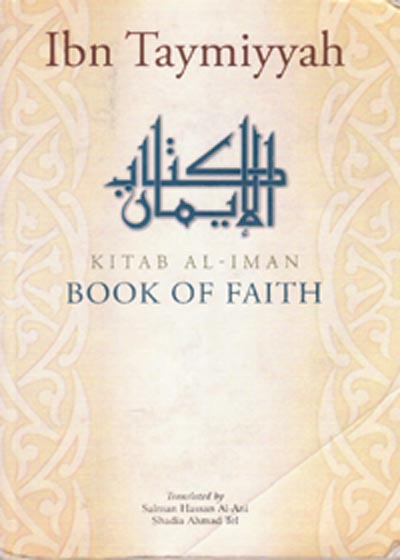
Kitab al-Iman English Ibn-Taymiyyah
Kitab al-Iman (Book of Faith) is a cornerstone theological work by the renowned 13th-century scholar Ibn Taymiyyah, focusing on the fundamental concept of Iman (faith) in Islam. This translation by Salman Hassan Al-Ani and Shadia Ahmad Tel provides the first complete English rendition of the text. Ibn Taymiyyah meticulously defines Iman based on the Qur’an, Sunnah, and the methodology of the Pious Predecessors. He systematically clarifies that Iman is a comprehensive reality that encompasses belief in the heart, utterance by the tongue, and action of the limbs. The work directly addresses and refutes the philosophical deviations of groups like the Murji’ah and Khawarij regarding the definition and relationship between faith and deeds, reaffirming the traditional Islamic understanding of faith as a complete and indivisible whole that increases and decreases.
Additional information
| Book Writer | |
|---|---|
| Language |
Description
Overview
Kitab al-Iman (Book of Faith) is a seminal theological work authored by the illustrious 13th-century Islamic scholar Ibn Taymiyyah. This book serves as a profound exploration of the concept of Iman (faith) in Islam, and it is regarded as a vital text for anyone wishing to deepen their understanding of Islamic theology. The English translation by Salman Hassan Al-Ani and Shadia Ahmad Tel offers the first complete rendition of this significant work, making it accessible to a broader audience. In this text, Ibn Taymiyyah meticulously delineates the nature of Iman, emphasizing its basis in the Qur’an and Sunnah, while also adhering to the methodology of the Pious Predecessors (Salaf). He articulates that Iman is not merely a theoretical construct but a holistic reality that integrates belief in the heart, verbal affirmation, and righteous actions.
Key Themes
This influential work addresses critical theological debates of the time, particularly countering the philosophical deviations of groups such as the Murji’ah and Khawarij. Ibn Taymiyyah’s arguments reinforce the traditional Islamic understanding of faith, positing that Iman is an indivisible whole that fluctuates in strength based on one’s actions and adherence to Islamic principles. Through systematic reasoning and references to authentic sources, the author clarifies the intricate relationship between faith and deeds, emphasizing their interdependence in the life of a believer.
- Students and scholars of Islamic theology seeking to understand the foundations of Iman.
- Individuals interested in the historical context and evolution of Islamic thought.
- Muslims aiming to strengthen their faith and comprehend its practical implications.
- Readers looking for a comprehensive examination of the relationship between faith and actions in Islam.
- Anyone wishing to engage with the works of Ibn Taymiyyah and his contributions to Islamic scholarship.