
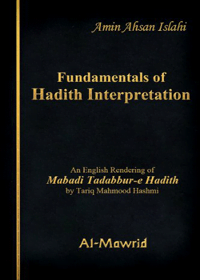
Fundamentals of Hadith Interpretation English Amin Ahsan Islahi
Fundamentals of Hadith Interpretation is a seminal monograph by the renowned Pakistani scholar Amin Ahsan Islahi (d. 1997). The work critically addresses fundamental questions about the prophetic tradition, most notably by establishing a clear distinction between Sunnah (the Prophet’s established practice), which is deemed an absolutely reliable source of religion, and Hadith (the verbal reports), which are seen as probable truths. Islahi sets forth principles for understanding Hadith, stressing the overarching authority of the Qur’an as the ultimate criterion to measure and sift sound reports from unsound ones. He argues that no Hadith can overrule the Book’s commands, making the Qur’an the true Mizān (balance) in all religious matters.
Additional information
| Book Writer | |
|---|---|
| Language | |
| File Size | 2.2 MB |
Description
Overview
The “Fundamentals of Hadith Interpretation” is a groundbreaking work by the esteemed Pakistani scholar Amin Ahsan Islahi (d. 1997), who delves into the intricate world of Hadith and its interpretation. This monograph serves as an essential resource for scholars, students, and anyone interested in understanding the nuances of prophetic traditions. Islahi meticulously articulates the differences between Sunnah and Hadith, emphasizing that while Sunnah represents the established practices of the Prophet Muhammad (peace be upon him) and stands as a reliable source of guidance, Hadith encompasses verbal reports that may vary in their authenticity. This critical distinction is vital for anyone seeking a deeper comprehension of Islamic teachings and their applications in contemporary life.
Key Themes
In this work, Islahi lays down foundational principles for interpreting Hadith, asserting the paramount authority of the Qur’an as the ultimate standard by which all Hadith must be measured. He posits that the Qur’an serves as the true Mizān (balance) in religious matters, thereby ensuring that no Hadith can supersede the commands of the Qur’an. Through rigorous analysis, Islahi provides readers with a framework to discern sound reports from unsound ones, fostering a more profound understanding of Islamic jurisprudence and ethics.
- Scholars and researchers of Islamic studies seeking a critical analysis of Hadith.
- Students of theology and religious studies desiring a deeper understanding of the relationship between the Qur’an and Hadith.
- Practicing Muslims aiming to strengthen their knowledge of Islamic teachings and prophetic traditions.
- Educators and teachers in Islamic institutions looking for comprehensive resources on Hadith interpretation.
- Anyone interested in the historical and theological context of Islamic jurisprudence and ethics.



/Maarif ul-Hadith-c1.png)