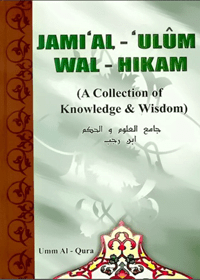
Jami al-Ulum wal-Hikam English Ibn Rajab al-Hanbali
Jami’ al-Ulum wal-Hikam (The Compendium of Knowledge and Wisdom) by Ibn Rajab al-Hanbali (d. 795 AH) is a seminal work in Islamic scholarship. It serves as an in-depth commentary on fifty essential, comprehensive hadiths (sometimes stated as forty-two, which includes Nawawi’s Forty Hadith), known for encapsulating the core principles of Islam. Ibn Rajab meticulously analyzes these narrations, drawing out their legal, moral, and doctrinal implications. The book is highly praised for its breadth of knowledge, integrating various streams of jurisprudence and theology, making it an indispensable resource for understanding the depth and universality of the Prophet’s sayings.
Additional information
| Book Writer | |
|---|---|
| Language | |
| File Size | 28 MB |
Description
Overview
Jami’ al-Ulum wal-Hikam (The Compendium of Knowledge and Wisdom) by Ibn Rajab al-Hanbali (d. 795 AH) stands as a monumental contribution to Islamic scholarship. This work is not merely a collection of hadith; it is a profound commentary on fifty pivotal hadiths—often referenced as forty-two, which includes the renowned Nawawi’s Forty Hadith. Ibn Rajab, with his meticulous scholarship, delves into these narrations, extracting their legal, moral, and doctrinal implications. The book is celebrated for its comprehensive approach, weaving together diverse strands of Islamic jurisprudence and theology, thereby illuminating the rich tapestry of the Prophet’s teachings.
Key Themes
This seminal text serves as an essential guide for both scholars and laypersons seeking to deepen their understanding of Islamic teachings. Ibn Rajab’s analysis does not merely focus on the surface meanings of the hadith; rather, it invites readers to explore the underlying principles that govern Islamic thought and practice. The work’s engagement with a multitude of perspectives ensures that it resonates with a wide audience, making it a vital resource for anyone interested in the ethical and spiritual dimensions of Islam.
- Students of Islamic studies seeking a deeper understanding of hadith literature.
- Scholars and researchers interested in the integration of jurisprudence and theology.
- Laypersons looking to enhance their comprehension of key Islamic principles.
- Islamic educators and teachers looking for authoritative references for their curriculum.
- Anyone interested in the moral and ethical teachings of the Prophet Muhammad (peace be upon him).