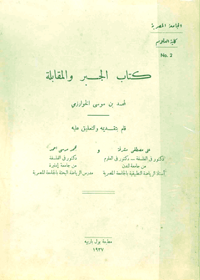
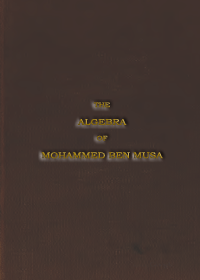
The Algebra of Mohammed Ben Musa-Frederic Rosen
The Algebra of Mohammed Ben Musa is Frederic Rosen’s essential 1831 English translation of Al-Khwarizmi’s foundational ninth-century Arabic text, Kitāb al-mukhtaṣar fī ḥisāb al-jabr wa’l-muqābala (The Compendious Book on Calculation by Completion and Balancing). This book introduced the systematic solution of linear and quadratic equations to the world, formally establishing algebra as an independent mathematical discipline. Rosen’s work provided the West with its first comprehensive access to the treatise that named the field of “Algebra” (from al-jabr) and contributed the concept of the “algorithm” (from Al-Khwarizmi’s name). It is a vital document in the history of mathematics, bridging the knowledge of earlier civilizations to the European Renaissance.
Additional information
| Book Writer | Abu ABdullah Mohammed Ben Musa al-Khowarezmi, Frederic Rosen |
|---|---|
| Language | |
| File Size | 7 MB |
Description
Overview
The Algebra of Mohammed Ben Musa, translated by Frederic Rosen in 1831, is a monumental English rendition of Al-Khwarizmi’s seminal ninth-century Arabic work, Kitāb al-mukhtaṣar fī ḥisāb al-jabr wa’l-muqābala, which translates to The Compendious Book on Calculation by Completion and Balancing. This foundational text is revered for its systematic approach to solving linear and quadratic equations, laying the groundwork for algebra as a distinct mathematical discipline. Rosen’s translation not only made this crucial work accessible to the Western world but also highlighted the intellectual contributions of the Islamic Golden Age to mathematics and science. The term “Algebra” itself derives from the Arabic word “al-jabr,” while the concept of the “algorithm” is rooted in Al-Khwarizmi’s name, showcasing the profound impact of this work on both mathematics and language.
Historical Significance
Al-Khwarizmi’s treatise is a vital link in the evolution of mathematical thought, bridging ancient knowledge from civilizations such as the Greeks and Indians to the burgeoning intellectual landscape of the European Renaissance. By providing clear methodologies and practical applications, this work not only revolutionized mathematical practices in its time but also paved the way for future advancements in various fields, including science and engineering. Rosen’s translation serves as a crucial resource for understanding the development of mathematical concepts and their historical context, making it essential reading for scholars, educators, and anyone interested in the history of mathematics.
- Students and educators looking to deepen their understanding of algebra and its historical roots.
- Historians and scholars researching the evolution of mathematical thought and its cultural exchanges.
- Mathematicians seeking to appreciate the foundational works that shaped modern mathematics.
- Anyone interested in the rich intellectual heritage of the Islamic Golden Age and its contributions to science.
- General readers who wish to explore the historical context of mathematical concepts and their applications.