
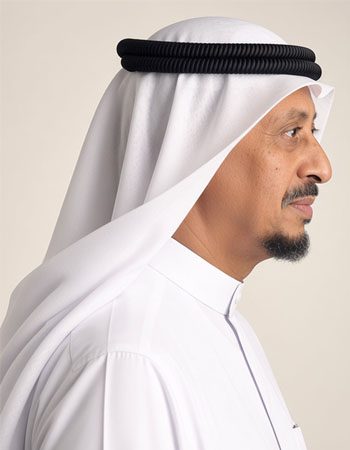
Shaykh Dr. Ahmed ibn Abdul Aziz Al-Haddad (b. 1955) is the Grand Mufti of Dubai and heads its Fatwa Department. He has held the post since 2011. He earned his PhD in Shari’a at Umm Al-Qura University in Makkah. He also sits on several fiqh academies: Dubai’s Authority of Senior Scholars, Abu Dhabi’s Fatwa Board, the OIC’s International Islamic Fiqh Academy, and, as an expert, the Muslim World League’s Fiqh Academy. Before that he taught as an associate professor at the College of Islamic Studies and at the Imam Malik College of Shari’a and Law.
His written work covers four areas: the Prophet’s character, classical Shafi’i fiqh, contemporary Islamic finance, and the discipline of fatwa itself.
Main works
- Akhlaq al-Nabi ﷺ fi al-Qur’an wa al-Sunnah (The Ethics of the Prophet ﷺ in the Qur’an and Sunnah, 3 vols). This is his best-known book. Its subtitle presents it as an applied study of Sayyida Aisha’s (RA) saying that the Prophet’s ﷺ “character was the Qur’an”. It links each Prophetic trait to its Qur’anic source.
- Minhaj al-Talibin of Imam al-Nawawi (critical edition, 3 vols). This is his scholarly edition (tahqiq) of the foundational Shafi’i legal text.
- Shares and Bonds: Their Conception and Rulings. A treatment of modern financial instruments under Shari’a.
- Fiqh al-Awqaf. The jurisprudence of Islamic endowments.
- Al-Fatwa: Ahkamuha wa Dawabituha. The rules and disciplines that govern issuing fatwas.
- The Importance of Collective Awqaf and Its Relation to Public-Interest Institutions. A study of endowments as a foundation for community welfare.
Beyond books
Much of his influence comes through other channels:
- Fatwas and articles. Thousands of them have appeared in newspapers and magazines in the UAE and abroad.
- Broadcasting. For about twenty years he has presented live fatwa and religious programmes on Dubai TV and other Gulf channels.
- Shari’a boards. He has served on the boards of Islamic banks, takaful (Islamic insurance) companies and the Zakat Fund. That work feeds directly into his writing on finance and endowments.
His public positions have sometimes drawn wide attention. For example, in 2009 he argued that a sufficiently learned woman may serve as a mufti, because the qualification is knowledge, not gender.
Legacy
His bibliography combines careful editing of classical texts with practical answers to modern questions about markets, endowments and how a fatwa should be issued. Taken together, it reflects a Gulf scholarly tradition rooted in the madhhab that still engages with contemporary life.


