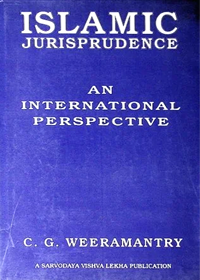
Islamic Jurisprudence an international Perspective-Hidayatullah
“Islamic Jurisprudence: An International Perspective” is a unique scholarly work that bridges the gap between Islamic legal tradition (Fiqh) and modern international law, featuring contributions from C. G. Weeramantry (former Vice-President of the International Court of Justice) and M. Hidayatullah (former Chief Justice of India). The book rigorously explores the profound ethical, environmental, and humanitarian principles embedded within Sharia law, demonstrating its relevance and potential contribution to contemporary international legal challenges. It highlights Islam’s ancient concepts of justice, human rights, and good governance, positioning Islamic jurisprudence not merely as a historical relic but as a sophisticated and living system with vital lessons for the global legal order.
Additional information
| Book Writer | |
|---|---|
| Language | |
| File Size | 20 MB |
Description
Overview
“Islamic Jurisprudence: An International Perspective” is a groundbreaking scholarly work that seeks to harmonize the rich traditions of Islamic legal thought (Fiqh) with the frameworks of modern international law. Authored by distinguished figures such as C. G. Weeramantry, a former Vice-President of the International Court of Justice, and M. Hidayatullah, a former Chief Justice of India, this book offers a comprehensive examination of the ethical, environmental, and humanitarian principles inherent in Sharia law. It underscores the relevance of Islamic jurisprudence in addressing contemporary global legal challenges, arguing that the ancient principles of justice, human rights, and good governance found within Islam are not merely historical artifacts but rather a living legal system that can contribute significantly to today’s legal discourse.
Key Themes
The authors delve into various aspects of Islamic jurisprudence, illustrating how its foundational concepts can inform and enhance the current international legal framework. The text emphasizes the importance of understanding Sharia as a dynamic source of guidance, capable of providing insights into pressing issues such as environmental sustainability and human rights. By examining the intersection of Islamic law and international norms, this book invites legal scholars, practitioners, and policymakers to reconsider the potential of Islamic legal traditions in fostering a more just and equitable global society.
- Legal scholars and students seeking a deeper understanding of Islamic jurisprudence and its relevance in modern contexts.
- Practitioners of law interested in exploring the intersection of Islamic law and international legal principles.
- Policy makers and diplomats looking for ethical frameworks that can guide international relations and humanitarian efforts.
- Anyone interested in the historical evolution and contemporary application of Sharia law in global legal discourse.
- Environmentalists and human rights advocates seeking to draw upon the ethical principles embedded in Islamic teachings.