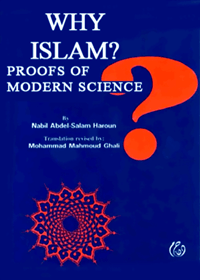
Why Islam? Proofs Of Modern Science
Why Islam? Proofs Of Modern Science by Nabil Abdel Salam Haroun, translated by Muhammad Mahmoud Ghali, is a work of apologetics that endeavors to establish the divine origin of the Qur’an using modern scientific and historical evidence. The book argues that many scientific facts and concepts, spanning fields like cosmology, embryology, and zoology, are accurately detailed in the Qur’an, despite having been unknowable at the time of its revelation. This convergence, the author contends, proves the Qur’an could not be the work of Prophet Muhammad (PBUH) or any human, but must be from a Superior, Absolutely Knowledgeable source—God. It serves as an intellectual invitation to embrace Islam based on the compelling, unequivocal harmony between its scripture and contemporary scientific discovery.
Additional information
| Book Writer | |
|---|---|
| Language | |
| File Size | 2 MB |
Description
Overview
“Why Islam? Proofs Of Modern Science” by Nabil Abdel Salam Haroun, translated by Muhammad Mahmoud Ghali, presents a compelling case for the divine nature of the Qur’an through the lens of modern science. This work of apologetics meticulously examines various scientific phenomena, revealing how they correlate with Qur’anic verses that were revealed over 1,400 years ago. The author explores diverse fields such as cosmology, embryology, and zoology, illustrating how the knowledge contained within the Qur’an aligns with contemporary scientific discoveries, which were, in many cases, beyond the understanding of people at the time of its revelation. This alignment suggests that the Qur’an is not merely a human creation but rather a text that emanates from a higher, all-knowing source—God.
Key Themes
This book serves as an intellectual invitation to readers, urging them to consider the profound connection between Islam and science. Through detailed analyses and thought-provoking arguments, Haroun articulates how the Qur’an’s insights into the natural world can lead one to recognize its divine origin. The text is structured to foster reflection and dialogue, making it a vital resource for those seeking to understand the intersection of faith and reason.
- Individuals seeking to strengthen their faith in Islam through intellectual inquiry.
- Students and scholars interested in the relationship between science and religion.
- Readers curious about the historical context of scientific knowledge in the Qur’an.
- Apologists and advocates of Islam looking for evidence-based arguments to support their beliefs.
- Anyone interested in exploring the harmony between contemporary science and religious texts.