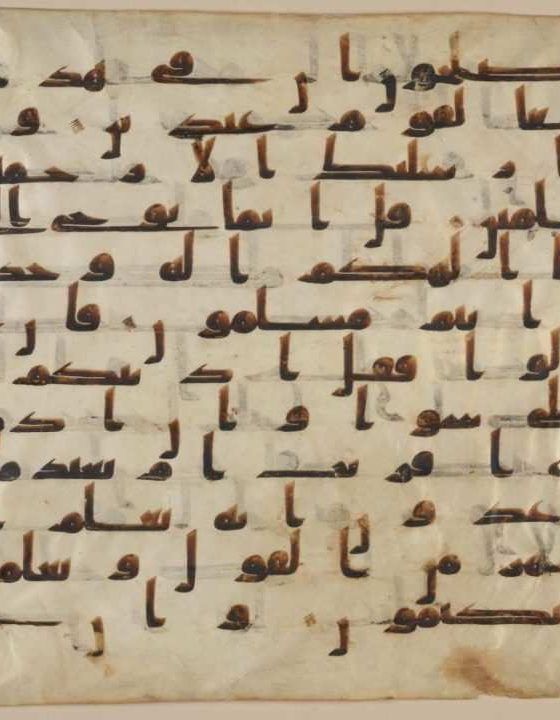
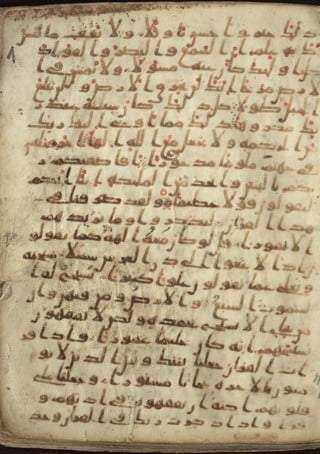
Al Quran Tübingen Fragment
Al Quran Tübingen Fragment
Year Written: c. 649 AD – 675 AD
Language: Arabic
Script Type: Hijazi
Current Location: University of Tübingen, Tübingen, Germany
References: medievalhistories.com
The Quran fragment from the University of Tübingen in Germany has been dated to a period between 649 AD – 675 AD. This date means the manuscript was written about 20 – 40 years after the Prophet Muhammad’s death. Pieces of the manuscript were analyzed in a lab in Zürich using modern C14-radiocarbon and dated within a 95.4% statistical probability.
The manuscript has been in the university’s possession since the 19th century when first Prussian Consul to Damascus, Johann Gottfried Wetzstein, acquired several ancient Arabic manuscripts. The research into the fragment’s age was conducted as part of a project funded by the German Research Society (DGF) and the corresponding French institution: Agence National de la recherché (ANR).
Additional information
| Language |
|---|
Description
Overview
The Al Quran Tübingen Fragment is a remarkable piece of Islamic heritage, dating back to approximately 649 AD – 675 AD, making it one of the earliest known manuscripts of the Quran. This fragment was written in Arabic using the Hijazi script, which was prevalent during the early Islamic period. The significance of this manuscript lies not only in its age but also in its connection to the formative years of Islamic text transmission, occurring just 20 to 40 years after the passing of the Prophet Muhammad (peace be upon him). The fragment is currently housed at the University of Tübingen, Germany, where it has been preserved since the 19th century, following its acquisition by Johann Gottfried Wetzstein, the first Prussian Consul to Damascus.
Significance and Research
This fragment serves as a crucial link to understanding the early textual history of the Quran. Its age was confirmed through rigorous analysis utilizing C14-radiocarbon dating techniques in a lab in Zürich, yielding a 95.4% statistical probability of its dating. This research was part of a collaborative effort funded by the German Research Society (DGF) and the French institution Agence National de la recherché (ANR), highlighting the importance of international scholarship in the preservation and understanding of Islamic manuscripts.
- Scholars and researchers interested in early Islamic texts and history.
- Students of Islamic studies looking to explore ancient manuscripts and their significance.
- Collectors of historical documents and artifacts related to Islamic heritage.
- Individuals seeking to deepen their understanding of Quranic transmission and early Islamic civilization.
- Institutions focused on the preservation and study of ancient manuscripts.