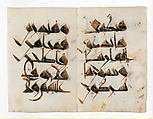
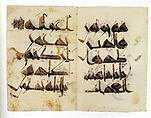
Bifolium from the “Nurse’s Quran” (Mushaf al-Hadina)
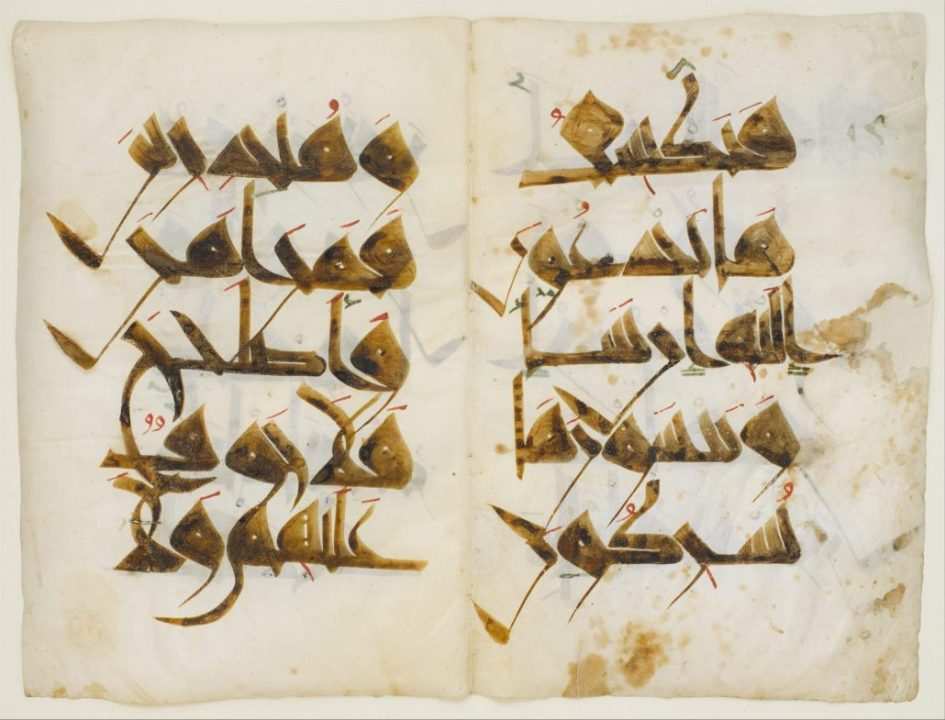
Bifolium from the “Nurse’s Qur’an” (Mushaf al-Hadina)
ca. A.H. 410/ A.D. 1019–20
This double-page from a Qur’an comes down to us with the fascinating information that the nursemaid to one of the Zirid rulers of North Africa commissioned it for donation to the Great Mosque of Qairawan. It is written in a form of the ‘new style kufic’ script that was unique to North Africa, and it was copied on parchment, which remained in use in this region long after paper was commonly used for Qur’ans from Egypt, Iraq or Iran.
(Downloads - 0)
Description
Overview
The Bifolium from the “Nurse’s Qur’an” (Mushaf al-Hadina), dating back to approximately A.H. 410/A.D. 1019-20, is a remarkable artifact that highlights the rich cultural and historical tapestry of North Africa during the Zirid dynasty. Commissioned by the nursemaid of a Zirid ruler, this exquisite piece was intended for donation to the Great Mosque of Qairawan, underscoring the importance of the Qur’an in both personal and communal contexts. The bifolium features a distinctive ‘new style kufic’ script, a calligraphic form that exemplifies the artistic innovations of the time, and is crafted on parchment, a medium that was favored in the region long after paper became the norm in other parts of the Islamic world.
Artistic and Historical Significance
This bifolium is not only a testament to the artistic prowess of its time but also serves as a reflection of the socio-political dynamics within which it was created. The unique characteristics of the script and material used provide invaluable insights into the regional practices of Qur’anic transcription and the cultural exchanges that defined North African Islamic art. The donation of such a significant piece to a major mosque further illustrates the role of women in the patronage of religious art and the enduring legacy of Islamic scholarship.
- Islamic scholars and historians studying the evolution of Qur’anic manuscripts.
- Art enthusiasts and calligraphers interested in the ‘new style kufic’ script and its historical context.
- Students and educators in Islamic studies looking to explore the cultural significance of regional Qur’ans.
- Collectors and museums seeking to preserve and understand important artifacts from the Islamic Golden Age.
- Individuals interested in the role of women in Islamic history and their contributions to religious and cultural heritage.