-
- Al Quran Manuscripts
Folio from a Quran Manuscript ca. 1180
- Folio from a Qur'an Manuscript ca. 1180 Written in Eastern or new style kufic script , line two of this folio includes two long, vertical letters (alif and lam), forming a distinctive pointed oval-shaped pattern. The elaborate treatment of the background, entirely filled with vegetal scrolls terminating in large blossoms so that the script seems to stand out against the…
-
- Al Quran Manuscripts
Bifolium from the “Nurse’s Quran” (Mushaf al-Hadina)
- Bifolium from the "Nurse's Qur'an" (Mushaf al-Hadina) ca. A.H. 410/ A.D. 1019–20 This double-page from a Qur'an comes down to us with the fascinating information that the nursemaid to one of the Zirid rulers of North Africa commissioned it for donation to the Great Mosque of Qairawan. It is written in a form of the 'new style kufic' script that…
-
- Al Quran Manuscripts
Folios from a Qur’an Manuscript A.H. 383/A.D. 993
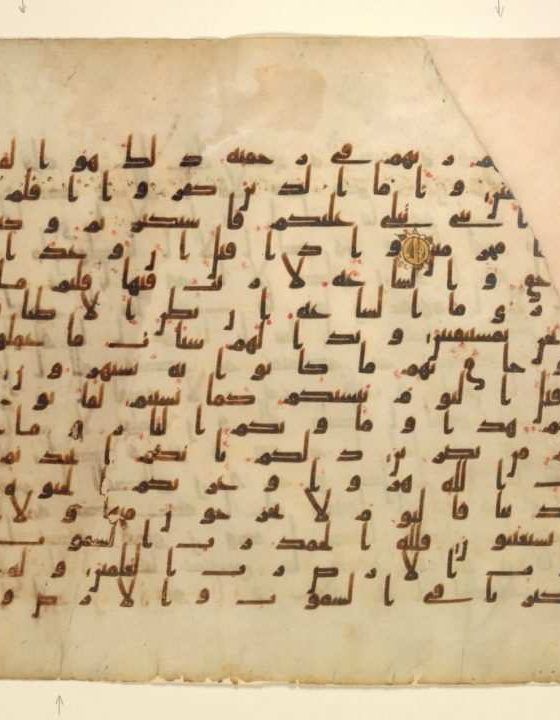
- Folios from a Qur'an Manuscript A.H. 383/A.D. 993 The first centuries in the copying of the Qur’an witnessed a succession of changing styles in the manuscript’s calligraphy, decoration, and format. This Qur’an shows many of the changes taking place in the medieval period. Whereas earlier Qur’ans were made of parchment and inscribed in a relatively simple kufic script, this manuscript…
-
- Al Quran Manuscripts
Quran Manuscript late 9th–early 10th century
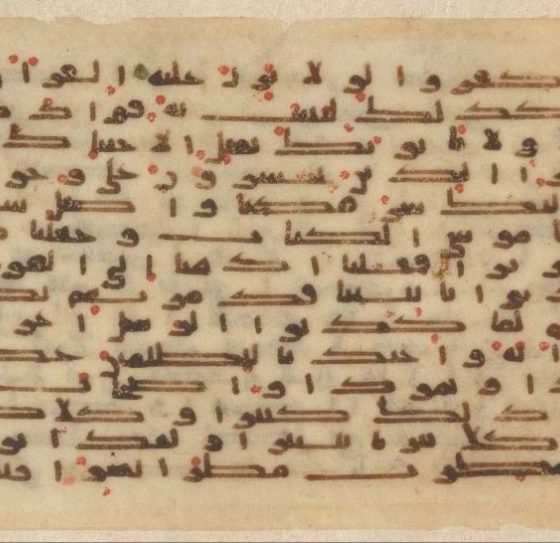
- Quran Manuscript late 9th–early 10th century This is the second volume of a thirty-part Qur’an meant to be read over the course of a month. It is typical of early Qur’ans, but includes some embellishments not found in earlier, more austere copies, such as red vowel marks, rosettes every ten verses, and double-page illuminations at the beginning and end of…
-
- Al Quran Manuscripts
Folio from the Blue Quran
- Folio from the "Blue Quran" This folio comes from a sumptuous, multivolume Qur'an with indigo pages and silver verse markers that was probably copied in North Africa. Its palette is thought to refer to the purple‑dyed, gilded manuscripts made in the neighboring Byzantine empire. As in other early Qur'ans, the script here is difficult to read because the letters have…
-
- Al Quran Manuscripts
Folio from a Quran Manuscript probably 9th century
- Folio from a Qur'an Manuscript probably 9th century The tradition of dyed manuscripts developed in Byzantium for making valuable books, such as the Gospels. The technique continued into the early Islamic period, with the Blue Qur’an as its most spectacular manifestation. Tinted pages were used only in the most luxurious manuscripts, for they required extra work in preparing the already…
-
- Al Quran Manuscripts
Samarkand Kufic Quran (Uthman Quran)
- This folio comes from one of the oldest surviving Qur'an manuscripts in existence. Year Written: c.765 AD – 855 AD Language: Arabic Script Type: Kufic Current Location: Hast Imam Library, Tashkent, Uzbekistan For several years, prior to research conducted in the last few decades, the Samarkand Kufic Quran, was thought to be the oldest copies of the Quran in existence.…
-
- Al Quran Manuscripts
Folio from a Quran Manuscript 9th century
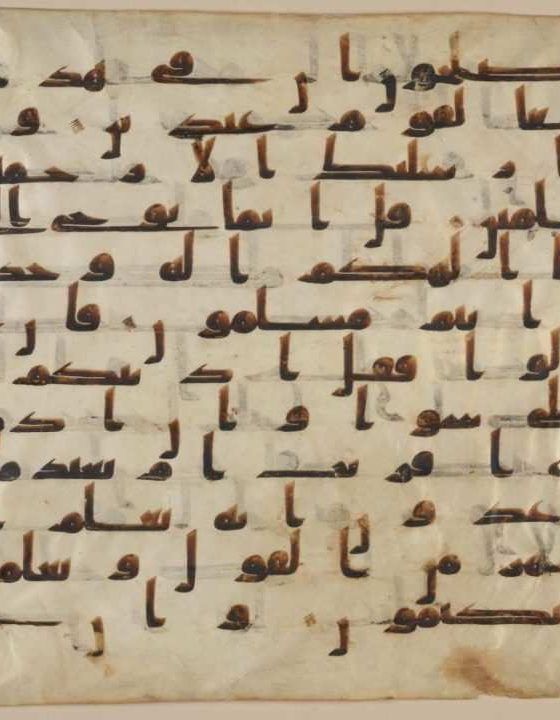
- This small-scale Qur'an was used as an intimate personal object, probably worn or carried as an amulet during travel. Despite its diminutive size, it shares many features with other early Qur'ans, which were often much larger and used as memory guides for public recitations. Here, densely packed writing in kufic script is lengthened horizontally, and red dots mark short vowels.…
-
- Al Quran Manuscripts
Folio from a Qur’an Manuscript late 13th–early 14th century
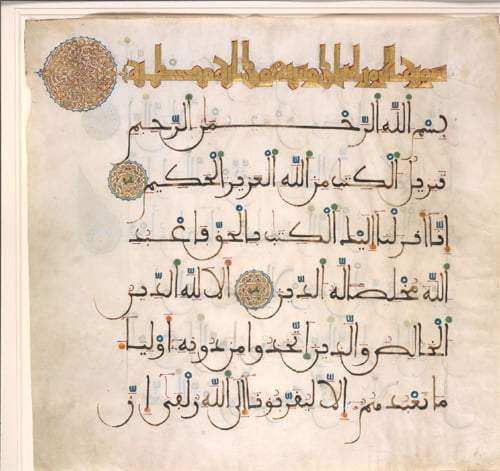
- This large folio comes from a magnificent two-volume Qur'an. In Spain, as in North Africa, Qur'an manuscripts and Qur'anic calligraphy retained archaic features long since abandoned farther east. Such features include the use of parchment instead of polished paper, a square format, and deep, rounded letter terminals, as seen in this example.
-
- Al Quran Manuscripts
Folio from a Quran Manuscript late 8th–early 9th century
- Folio from a Qur'an Manuscript late 8th–early 9th century This eighth- or ninth-century Qur'an was written in a script that is characterized by a rightward slant and by the shape of the vowel ya' in the terminal position, which turns backward to underline the letters that precede it. Like other early Qur'an manuscripts, the writing here omits consonant points (i'jam),…
-
- Al Quran Manuscripts
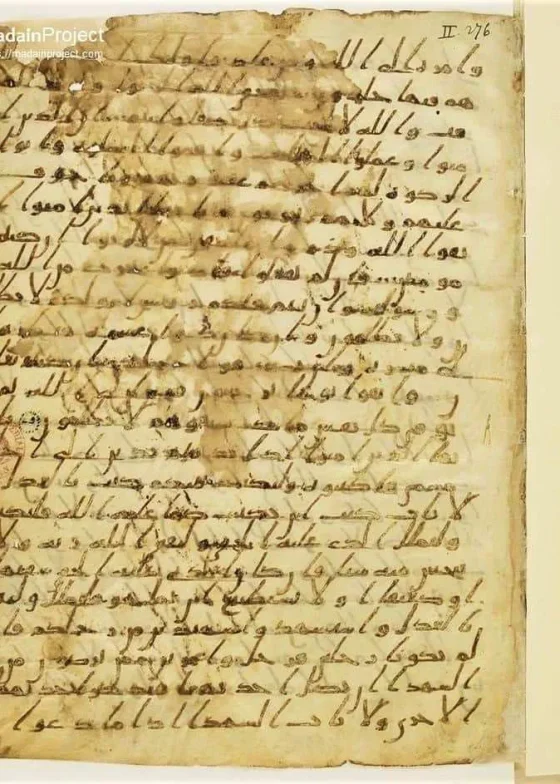
Al Quran Codex Parisino-Petropolitanus
- Codex Parisino-possibly the oldest extant Quranic manuscript Year Written: c. late 7th to early 8th century Language: Arabic Script Type: Hijazi Current Location: 70 folios at Bibliothèque nationale de France, Paris; 26 folios at the National Library of Russia in Saint-Petersburg, Russia; 1 folio in the Vatican Library; and 1 folio in Khalili Collection in London References: Madain Project, Wikimedia…